Cooking & Recipes
Pokémon Quest Recipe Quality: Points, Tiers & Mistakes
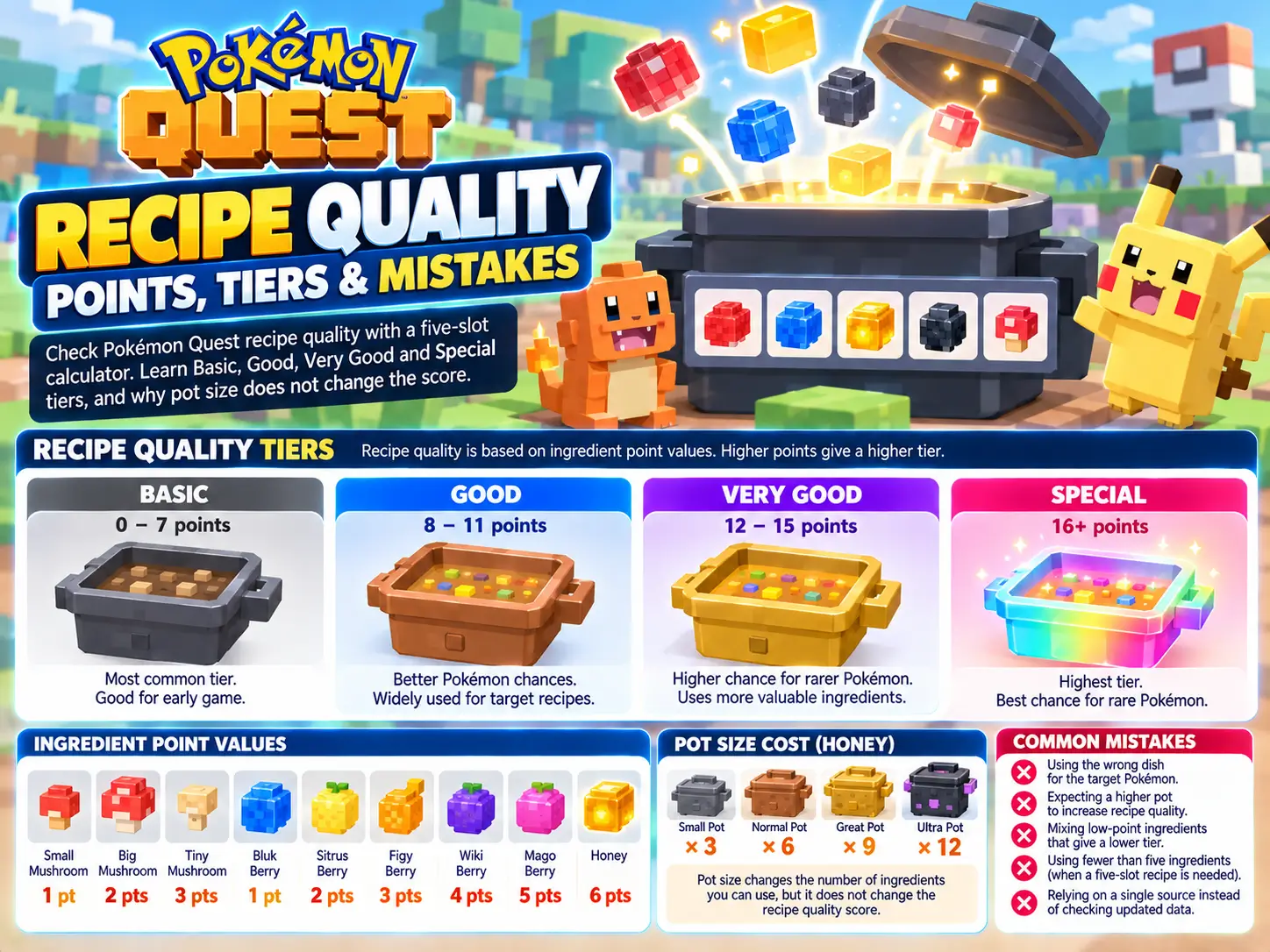
Recipe quality comes from the ingredients in five slots. Add their points once per slot, then check the dish separately. A Gold pot does not automatically make a Special recipe.
Check the quality of five slots
Choose the ingredient in each slot. This checks the points only. It does not identify the resulting dish or promise a visitor.
Use the full recipe finder to check dish rules and attraction pools. The pot size does not multiply this score.
The four quality bands
| Points across five slots | Quality | What to check next |
|---|---|---|
| 5 | Basic / Normal | Is your target in this dish’s Basic pool? |
| 6–7 | Good | Did a substitution also change the dish? |
| 8–9 | Very Good | Compare the target’s chance with cheaper tiers. |
| 10 or more | Special | Confirm the rare ingredients are worth spending. |
Small ingredients contribute one point each. Big Root, Icy Rock, Honey and Balm Mushroom contribute two each. The model used here also counts Mystical Shell as two and Rainbow Matter as three. This is the same scoring convention used by our current finder.
Five full slots cannot total less than five in this convention. Some references use a zero-based score that subtracts one point per slot. Do not combine a zero-based ingredient table with the thresholds shown above.
Add points once per slot
For three Bluk Berry slots and two Apricorn slots, the calculation is 1 + 1 + 1 + 1 + 1 = 5. That remains Basic whether the pot spends 15 items or 100 items. The Abra guide uses this exact Brain Food mix.
Now replace one Apricorn with Honey. The total becomes six. This explains the new quality band, but it does not prove that the result is still Brain Food: Honey also changes the hard/soft balance. Always check the complete mix after replacing an ingredient.
Quality, dish and pot answer different questions
| Question | What answers it |
|---|---|
| Which kind of meal will I cook? | The full combination and recipe matching rules |
| Which quality band is it? | The five-slot point total |
| How much will leave my bag? | The pot amount multiplied by each slot count |
| Which Pokémon can arrive? | The resulting dish and quality pool |
Write those answers on separate lines before an expensive cook. It is easier to spot a mistake when “Special” is not being used as shorthand for “Gold pot,” “rare visitor,” and “best recipe” all at once.
Why higher quality can be the wrong goal
Imagine that your target has a strong chance in a cheap pool. Spending precious ingredients to move into a different pool can introduce more possible visitors. You paid more, but did not necessarily improve your chance of the Pokémon you wanted.
The Machop guide shows why Good and Very Good deserve separate comparisons. Choose the target first, then choose a documented mix. Upgrade a dish because the new pool suits your goal, not simply because its label sounds better.
A useful budget question is: “How many attempts can I afford with the ingredients I have?” If your mix uses a resource you are saving for another Pokémon, compare an alternative before cooking.
Before you press Start Cooking
- Fill exactly five ingredient slots.
- Check the quality total using one scoring convention.
- Confirm the dish in the recipe finder.
- Check your chosen Pokémon’s dish-quality pool.
- Multiply each slot count by the pot cost and check your bag.
Take a screenshot of the five slots if you are comparing conflicting recipes. A dish name alone leaves out the quality and pot details needed to diagnose the result.
Quick questions
Does a Gold pot make every recipe Special?
No. The five selected ingredients determine this quality score. Pot choice changes the amount spent and other visitor characteristics.
Can I use the calculator as a complete recipe checker?
No. A point sum does not evaluate colour, texture, ingredient properties or recipe priority. Use the main finder for the dish and visitor pool.
Sources and useful next steps
These references support the game facts above. Recipe probabilities are community reference values; individual results can differ.

About the author
Rizwan Aslam is the creator of Pokémon Quest Recipes. This guide explains documented game mechanics and practical planning examples; it does not claim independent drop-rate testing.
About Rizwan · How we check our guides · Report a correction
1 thought on “Pokémon Quest Recipe Quality: Points, Tiers & Mistakes”